

Last Updated: 01/06/2026
How to Puppy-Proof Your Home and Garden
Welcoming a new puppy? Learn how to identify hidden hazards, manage toxic plants, and create a secure "safe zone" for your newest family member.
Author: Dr Gillian Hill BVSc (Hons)
Reading Time: 10 minutes - short read
Bringing a new puppy home is one of those moments you'll remember forever - the wagging, the wriggling, the absolute chaos of a small creature discovering every corner of your house at top speed. It's pure joy.
But just like a curious toddler, puppies explore the world with their mouths and their noses, and that means our homes - which seem perfectly safe to us - can harbour some unexpected hazards for them.
The good news? A bit of preparation before your pup arrives goes a long way. Our Vet Squad has put together this room-by-room guide to help you create a home that's safe, welcoming, and ready for adventure. Think of it as your 20-minute checklist that could save a lot of heartache down the track.
Why puppy-proofing matters: Seeing your home through their eyes

Before you dive into the checklist, it helps to understand why puppies are so vulnerable in a new environment - and it comes down to three things.
1. Puppies explore with their mouths
Chewing, mouthing, and tasting objects is completely normal puppy behaviour - it's how they learn about the world. This isn't naughtiness; it's biology. But it does mean that anything within reach is fair game, from power cords to toxic plants to the contents of your bathroom bin. Stock up on a range of puppy-safe toys before your new pup arrives. Having these on hand provides an immediate, appropriate outlet for their natural urge to gnaw and makes it much easier to redirect them away from dangerous alternatives.
2. Small size changes the risk equation
A puppy's low body weight means that toxic doses of household chemicals, medications, or poisonous plants can be reached very quickly - far more so than for an adult dog. Their small airways also make choking a genuine concern, even for objects that seem harmless.
3. They can access spaces we don't think about
Behind appliances, under fences, inside low cupboards - puppies find gaps we'd never notice. This is why we recommend doing a dedicated walk-through of your home and garden before your puppy arrives, crouching down to their level to see what they'll see.
Vet Squad Tip: Do your walk-through at least a week before your puppy is due home. That gives you time to fix any household hazards without rushing - and to involve every member of the household, since different people will spot different risks.
Puppy-proofing room by room

Work through each area of your home systematically. And keep in mind - revisit this checklist as your pup grows, because a curious four-month-old has very different capabilities to a tiny eight-week-old!
Give your puppy their own safe space

One of the best things you can do for a new puppy is create a designated, secure space that's entirely their own - somewhere they can retreat to when they're tired, overwhelmed, or just need a break from the household activity.
Crate training is one of the most effective ways to do this. A well-introduced crate isn't a punishment - it's your puppy's bedroom. When you can't have eyes on your pup every second (and you won't be able to), a crate gives you peace of mind that they're safe and not getting into mischief behind the couch.
A puppy playpen is another great option, particularly for the early weeks - it gives your pup a safe, contained area with their bed, water, and a few toys, without the full run of the house while they're still learning the rules.
Read through our guide to How to Set Up Your Home for Your New Puppy for advice about setting up feeding and sleeping stations, as well as creating a routine from day 1.
Our Vet Squad recommends: wire crates (allow good airflow and visibility), soft-sided playpens for daytime containment, puppy gates for blocking off rooms, and a cosy crate pad or mat to make the space feel safe and comfortable from day one.
Supervise, supervise, supervise
The single most effective puppy-proofing tool is you. No amount of cord-tidying or cabinet-locking replaces active supervision, especially in the first weeks when your pup is still learning what's theirs to chew and what isn't.
When you can't supervise directly - whether you're in a meeting, cooking dinner, or asleep - use your crate, playpen, or a puppy-proofed room as a safe space. This isn't about restricting your puppy; it's about setting them up to succeed.
Puppy Proofing Checklist

- Electrical cords secured or covered
- Toxic indoor plants moved or rehomed
- Child-proof locks on low kitchen and bathroom cabinets
- All medications in a locked, elevated cabinet
- Bins lidded or stored in a locked cabinet
- Small objects cleared from all floors (coins, buttons, hair ties, rubber bands)
- Shoes and clothing stored in closed wardrobes
- Toilet lid closed; bath drained after use
- Washing machine and dryer doors kept closed
- Fence perimeter checked and all gaps sealed
- Gate latches secure; household briefed on always closing gates
- Pool and water features fenced or drained
- Garden chemicals in a locked shed or elevated storage
- Toxic garden plants identified and removed
- Compost bin securely lidded and inaccessible
- Crate or puppy safe space set up and ready
- Vet registered; first appointment booked
- Animal Poisons Helpline number saved: 1300 869 738
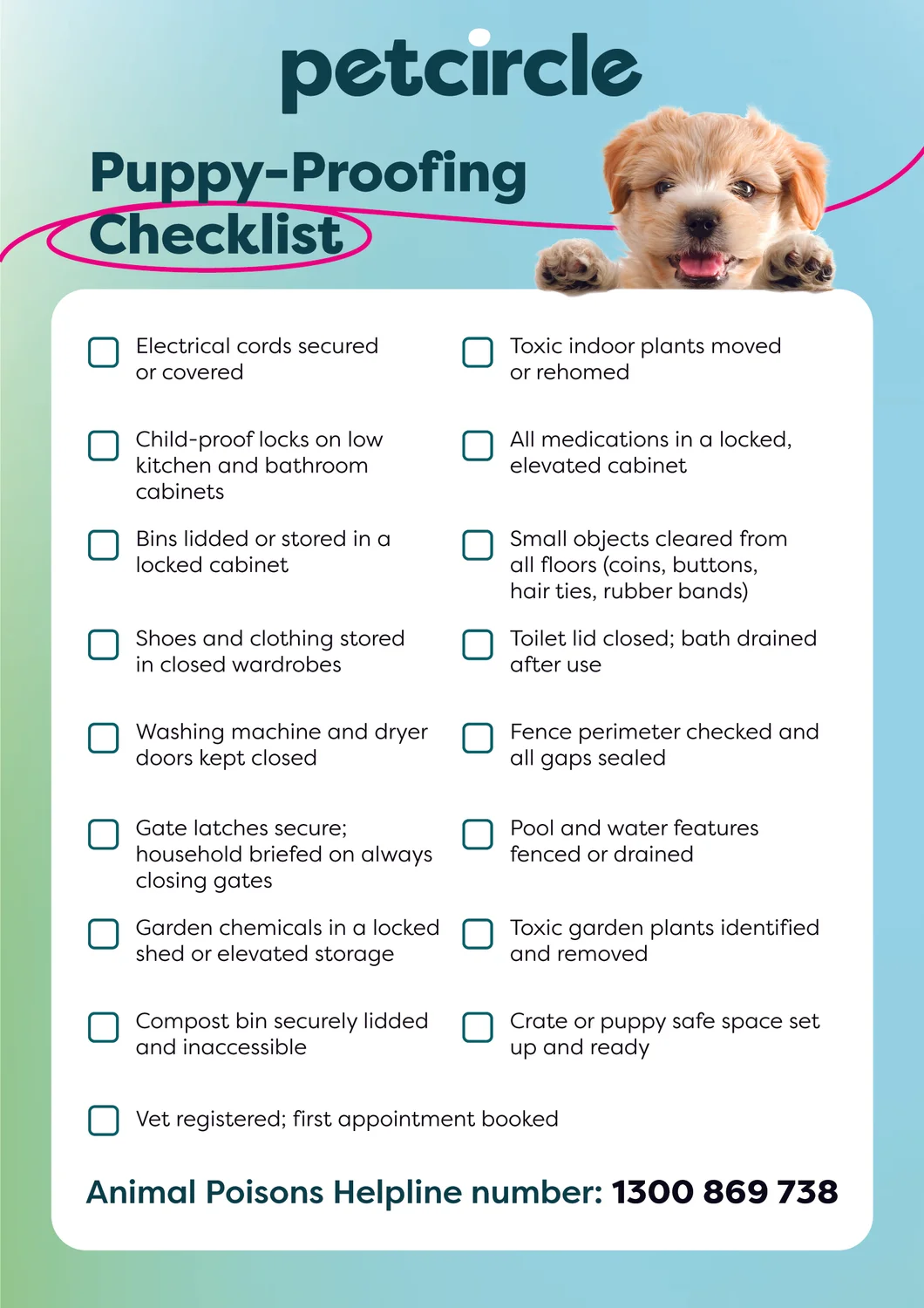
Your Free Puppy-Proofing Checklist (Every Room + Garden)
We've turned this entire guide into a free, printable checklist you can stick on the fridge or share with the rest of the household.
It covers every room and the backyard, plus the emergency numbers worth having on hand - so you can tick off each hazard as you go and feel confident your home is ready before your puppy walks through the door.
Download it, print it, and work through it at your own pace in the week before your pup arrives.
If you're unsure about a specific plant, chemical, or product in your home, don't guess. Your vet or the Animal Poisons Helpline can give you a fast, accurate answer.
If your puppy is unwell or has already eaten something you're concerned about, please contact your vet or an emergency animal hospital immediately - don't wait to see what happens. Fast action makes a significant difference in outcomes.
The best time to find your nearest vet is before you need one urgently. We recommend registering your puppy with a local vet within the first week of bringing them home.
Our Pet Circle Vet Squad is also available for general questions via our free online vet service.
Puppy Proofing FAQs
A bit of preparation goes a long way. By walking through your home and garden before your puppy arrives - fixing the hazards, setting up a safe space, and knowing what to do in an emergency - you're giving your new pup the best possible start.
And once the puppy-proofing is done? You can focus on the things that really matter: the cuddles, the playtime, and the very particular joy of watching a small, chaotic creature figure out the world - safely, in your home.
Articles recommended for you
Does your dog struggle with barking, digging, or anxiety? Discover the root causes of common canine behaviour issues and explore practical, vet-led solutions to help your furry family member feel calm, secure, and happy in your Australian home.
Is your cat scratching the sofa or disturbing the households sleep at night? Many problem behaviours are actually natural instincts. Learn how to manage scratching, anxiety, and boredom with practical, vet-led advice to create a harmonious home for your cat.
Does your pet suffer from anxiety? Check out our Vet-guide for treatment options to help your pet.
Do you own a cat with stress or anxiety? Check out our complete guide to using feliway.
Do you own a dog with anxiety? Check out our complete guide to using adaptil and the best time to use it for maximum results.
Separation anxiety is becoming a common problem in dogs. Read for solution and causes.
History
Our experts continually monitor the health and wellness space and we update our articles when new information becomes available.
Tue 12 May 2026
Written by Dr Gillian Hill BVSc (Hons)Dr Gillian Hill BVSc (Hons)
Veterinarian
Dr. Gillian graduated from the University of Sydney in 2005 with a Bachelor of Veterinary Science. She worked in a number of small animal clinics, before joining the Pet Circle Vet team in 2020. Dr. Gillian has special interests in ultrasonography, surgery and behaviour. Her favourite part of being a vet is being an advocate for the animals. She loves helping owners to make the best, evidence-based decisions for their pets, and seeing the beautiful bond that people have with their fur-babies.


